Tuesday, December 9, 2008

Michele's Road

Here's an additional image sent to me by Michele, who took #2 and edited it to show what she would do. She says:

"My goal was to have the viewer be led into the picture at the start of the road (lower left). And then travel through the picture following the road all the way to the top left. Finally, the viewer would come back down to the beginning of the road. I’m not sure about the large bush on the bottom right (I don’t want the viewer to be distracted by it), but something was needed as there was a large empty space."

Good job, don't you think? I particularly like the opening in the tree line that allows you to travel farther back into the frame.

I'd love to see anyone else's tweaks, too! Feel free to noodle around with the pix and see what works and why...

Thanks so much, Michele!!


Saturday, November 29, 2008

The Road Keeps Changing...

I'm deep in the throes of re-writing my book, Landscape Painting in Pastels. It will eventually be available for download or to purchase as a paperback or hardbound version through one of the online publishers. I'd like to get it done this year but that seems to be a little more than a month away now, so I'm not sure! At the moment I'm trying to locate or paint some effective illustrations for it, which is how I happened to find this little demo recently. It shows how you can recompose a foreground to make it stronger or more interesting.

The foreground is such a tricky and demanding area! It simply HAS to support the area of interest, if that should lie outside the foreground, or if it contains the area of interest it has to aid it in an effective way. I've seen some pretty lazy and weak ways people handle the foreground, (uh oh--myself included!), such as simply minimizing it to nothing and ending up with things seated on the 'windowsill' of the painting. I've spent some time studying what it is that makes the foreground plane work. The book has a lot more information, of course, but to summarize I'd say the two key elements of a foreground are shapes (which is what this demo shows) and patterning.

I used a piece of recycled Wallis paper for this demo, so you can see a ghost of the previous image's colors underneath. I find that I can ignore such remnants pretty easily and often reclaim the paper by simply rubbing out the painting that was there. I did the drawing with extra soft thin vine charcoal (Grumbacher #2.) The changes were easy on the toned surface of the Wallis. I just used my foam brush to swish things away and redrew them.

I'm showing the contours of the land plane here. It's always advisable to understand where the land twists and turns, and adding a road cutting through these planes is an effective way to show them. Roads are compelling devices--they lead the eye to the end of the road no matter what! So the question becomes how you can use that compelling movement to your advantage. You'll notice that the mountains don't change in these three images. That's because I changed the drawing to illustrate how a road can work differently.

1.2.

3.

My challenge to you is to study these three and decide which you think is most effective and WHY. It isn't a matter of "I like it best", which isn't an invalid response, just not useful here except maybe to get you started thinking about why you like it. This is a chance to look at each one and decide what works. What is the area of greatest interest? (**Note: NOT the focal point. This isn't a photograph.) What SHAPES contribute to that best? What visual path does your eye take through the whole composition? Where does it start and stop? What would you plan to add and where?

Better yet, feel free to copy them and ADD TO them, (right click, Save Picture As) rearrange the shapes, and then show me what you did... Does it need a bush or tree or fence posts? Would you add to the sky, or include a car or a cow? You can e-mail it to me deb(at symbol)deborahsecor.com and I'll post it, if you like, since I don't know if you can include images in the comments.

I'll tell you what I think about each one later! Suffice it to say that there's room for improvement on each of these. Have some fun and tell me what you think. Pass the word and invite anyone to join us!

Thursday, November 20, 2008

Thankfulness

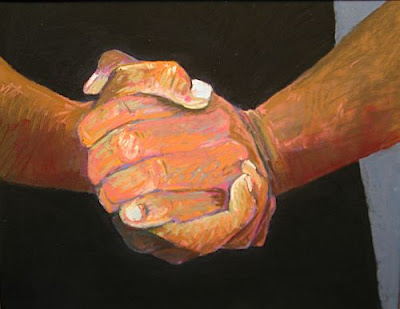
Grace
Soft pastel, 8x10"

This is a painting I've had for a while but I love the simple expression of gratitude. One of the pastors from our church 'posed' for my camera when I asked him to show me how he prayed. I think I captured the sincerity and fervency that characterize his life and walk with the Lord Jesus. May we all be so sincerely and fervently thankful!

Tuesday, November 18, 2008

Coronado Sky, 9x12"
pastel on R-tis-tx panel

$200 delivered to your door

This one was painted a while ago but I shot a good photograph of it yesterday, and I love that it shows the delicate color built up in the clouds. This is an area north of Albuquerque along the Rio Grande, at Coronado Monument. It has all the elements of a typical southwest view--miles of vistas, mesas, mountains, cottonwoods and that seemingly endless sky!

In this season of thanks I want to note how grateful I am to the Lord that He has given me such beauty to enjoy and share. It's a great blessing to be an artist!

Monday, November 10, 2008

Welsh Springer

Welsh Springer
12x12"
pastel on Wallis sandpaper
This one was done as a demonstration for my class. If you'd like to see the progress of it you can go to a thread I started on WetCanvas! Welsh Springer- portrait demo

You can also check out my newly designed web pages to see more animal paintings at http://www.deborahsecor.com/!